

Get Your Hearing Tested in a Calibrated Sound Booth
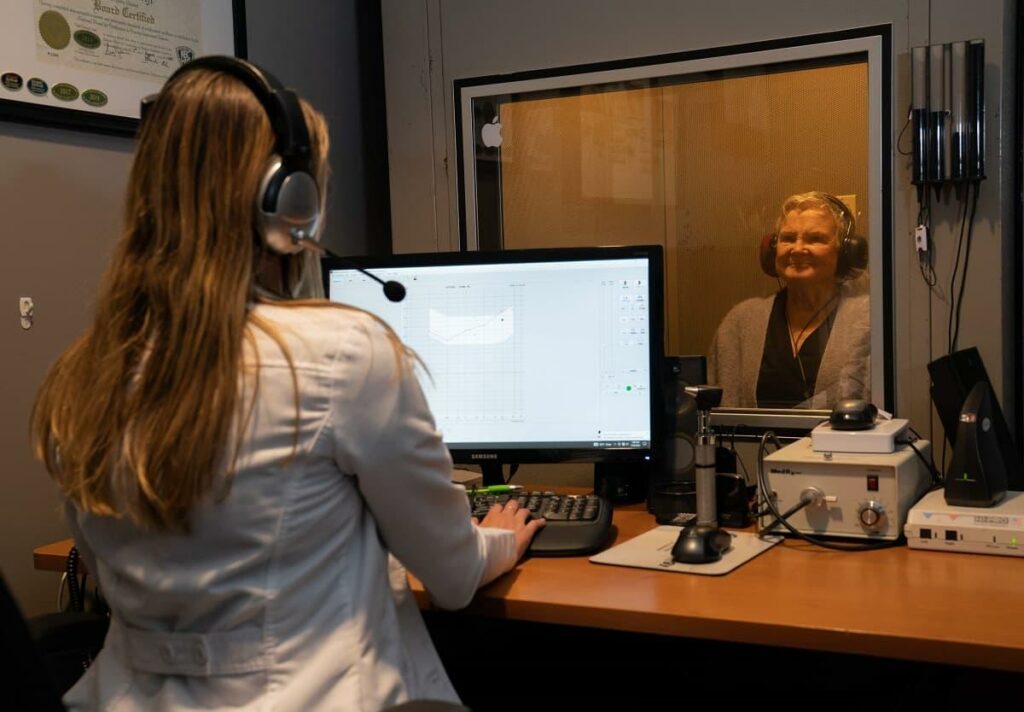
It is crucial to have your hearing tested in a properly calibrated sound booth to ensure accurate results. These results are later used to program the correct prescription into your hearing aids, so it is important to get it right the first time.
What can I expect when seeing an Audiologist for a hearing test?
You will be greeted by one of our friendly, fully trained reception team and introduced to your Audiologist who will assess the health of your ears.
Your clinician will take a medical case history, this means asking you some questions about your general health and in particular about your ears and your hearing. They will also ask you about various hearing situations to get an idea of how your everyday life might be affected by your hearing.
Your Audiologist will then carry out a number of tests on your hearing to find out exactly how well you are hearing.
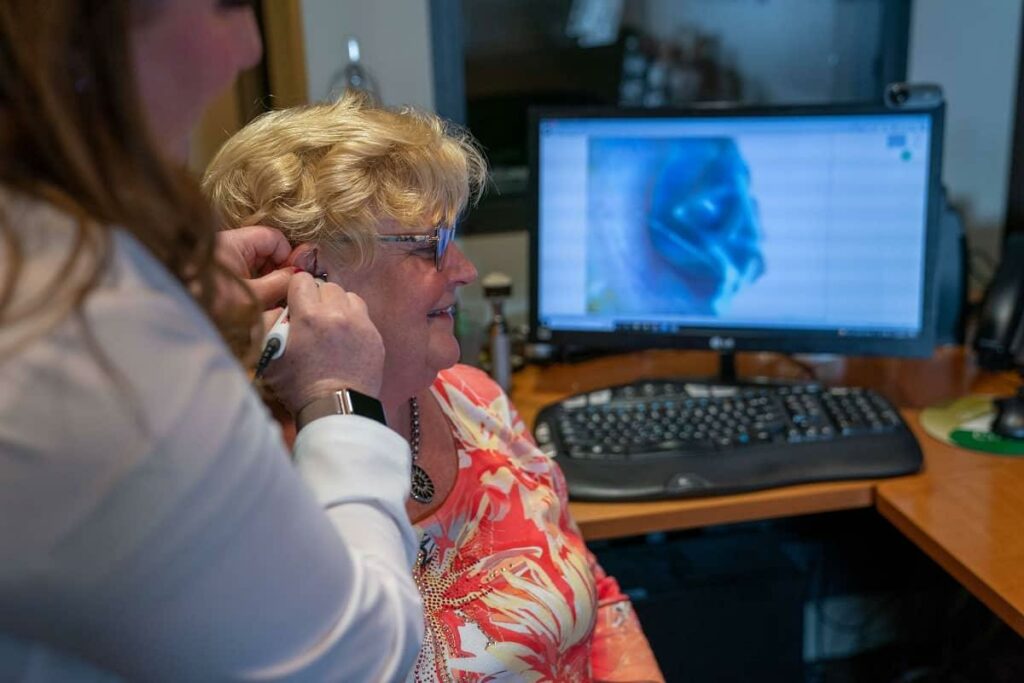
Is It Just Ear Wax?
Sometimes, yes — and it’s worth ruling out first. We examine your ears before testing to check for significant earwax buildup, which is a common and easily treated cause of muffled hearing. If we find it, we can gently remove it before your test so your results reflect your actual hearing rather than a blockage.
Specialized Hearing Tests and Equipment
We use a mix of specialized tests — including pure tones, speech in quiet, and speech in noise — to accurately assess your hearing. Each measures something different, and together they show not just whether you have hearing loss but what kind.
The results give your audiologist a clear picture of the type and degree of your hearing loss, and which sounds you may be missing in day-to-day life. Speech-in-noise testing matters most here — trouble following conversation in a restaurant or a group is what most people notice first, and it's the part a basic screening won't catch.
Sometimes hearing loss is the result of another medical condition that should be treated before hearing aids become an option. If that's the case, we'll refer you to a physician who specializes in ear disorders. This isn't common, but identifying it is part of what a full diagnostic evaluation is for.
How Long Does a Hearing Test Take?
A hearing test typically takes about 15 to 30 minutes, depending on the complexity of the evaluation. The appointment may take longer if additional testing is needed or if a hearing aid assessment is also being completed.
Does insurance cover the test?
In most cases, yes. Because we are audiologists rather than hearing instrument specialists, we can bill insurance for a diagnostic hearing test. Medicare covers the test when it is ordered by your physician, and most major plans — including BCBS and Cigna — cover diagnostic testing, though coverage details vary by plan. Call our office with your insurance information and we will verify your benefits before your appointment.
What’s the difference between a hearing screening and a hearing test?
A hearing screening is a quick pass/fail check that tells you only whether you may have hearing loss. A diagnostic hearing test, performed by an audiologist in a calibrated sound booth, measures the type, degree, and configuration of your loss across frequencies — the information needed to actually treat it.
What a screening does. Screenings are brief, often free, and frequently done outside a controlled environment — a tablet app, a booth at a health fair, a kiosk in a retail store. They present a few tones and record whether you responded. The result is binary: pass, or “you should get this looked at.” That’s genuinely useful as a prompt to seek care. It is not a diagnosis, and it doesn’t tell you what kind of hearing loss you have or what’s causing it.
What a diagnostic test does. A full evaluation is performed by a licensed audiologist in a sound booth calibrated to industry standards, so ambient noise can’t skew your results. It includes an ear exam to check for wax or structural issues, pure-tone testing across the speech frequencies, and speech testing in both quiet and background noise. Speech-in-noise testing matters most — difficulty in restaurants and group conversation is what most people actually notice first, and a screening won’t catch it.
Why the distinction matters. Hearing loss has causes. Some are medical and treatable — impacted earwax, fluid, infection, and, rarely, conditions that need a physician’s attention. A screening can’t tell those apart from age-related nerve loss, which means it can’t tell you whether you need a hearing aid, a wax removal, or a referral. Buying an over-the-counter device based on a screening means treating a symptom without knowing the cause.
A diagnostic test produces an audiogram — a frequency-by-frequency map of your hearing in each ear. That map is what any hearing aid must be programmed against, and it’s the baseline every future test gets compared to.
Which do you need? If you’re wondering whether something has changed, a screening is a reasonable first step. If you’re having trouble following conversation, asking people to repeat themselves, or thinking about hearing aids — including over-the-counter ones — you want the diagnostic test. You can’t fit a device correctly to a pass/fail result.
Hearing Aid Repair
We work with all the major hearing aid brands and can service, repair, and re-tune your existing devices.
Tinnitus Treatment
Do you have ringing in the ears? Our trained specialists can help you with answers and solutions.
Hearing Evaluation/Testing
The first step on your journey to better hearing is a comprehensive assessment of your ears and hearing.