
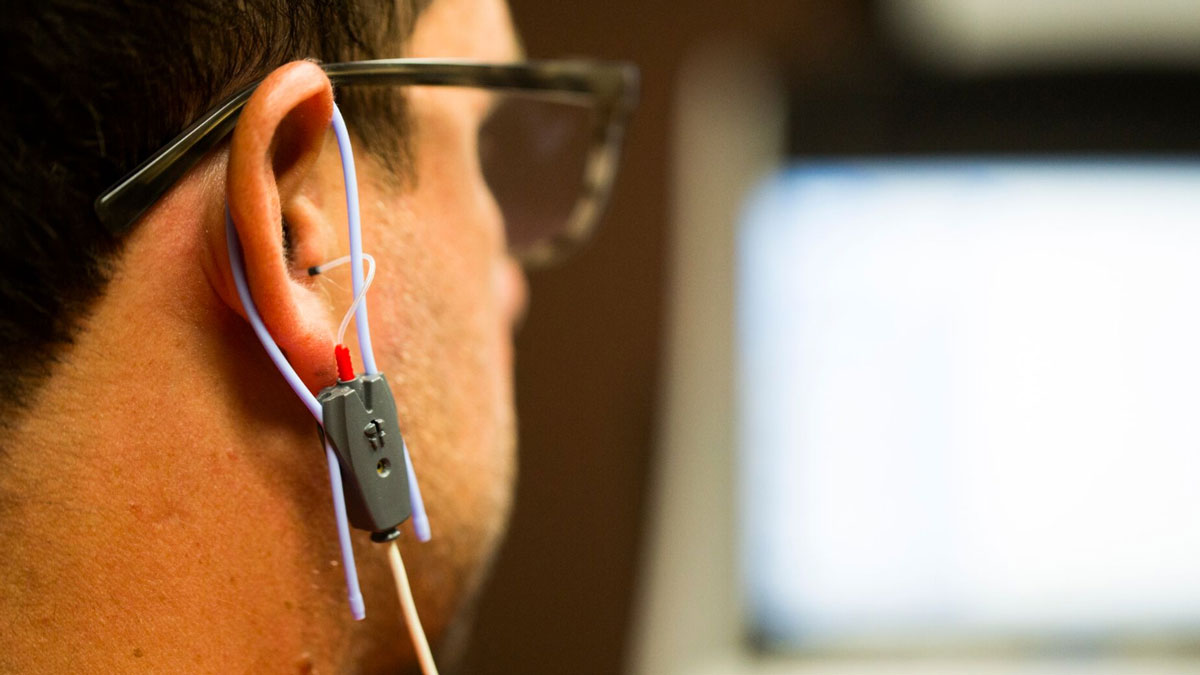
Real ear measurement (REM) is the only way to confirm that your hearing aids are actually delivering the sound your prescription calls for. Hearing aids do not come out of the box ready to wear — they have to be programmed to your hearing loss and then verified in your ear. Even top-of-the-line hearing aids can be rendered useless if best practice standards are not followed.
A thin probe tube attached to a microphone is placed in your ear canal, very close to the eardrum, while you wear your hearing aids. We then measure the output of the hearing aid in decibels — for both conversational speech and loud sounds — and compare it against your prescriptive targets. The result is a graph of the sound levels actually reaching your eardrum, which is why REM has been the gold standard for hearing aid verification for years.
Placement matters. The tube sits within millimeters of the eardrum, and it has to be positioned by an audiologist trained in ear canal acoustics — a few millimeters off changes the reading. Without this measurement, a provider is relying on the manufacturer’s “first fit,” a default setting based on averages rather than on your ear.
Few clinics perform real ear measurements despite evidence that shows patients are more satisfied with their hearing aids when real ear measurement is performed.
Ericka DeVore, Au.D
Measuring and interpreting these acoustic gain curves requires a good knowledge of acoustics. Only audiologists have 4 years of graduate work and courses in acoustics.
Busy corporate run practices know that time is money and the goal is to see as many patients as quickly as possible. Adding additional time to do tests that are unpaid is not logical to them.
There is no requirement that hearing aids be tested to make sure they are fit properly for a particular hearing loss. They are only tested for meeting factory specifications.
The cost of the equipment is several thousand dollars and insurance does not allow audiologists to bill for those tests.
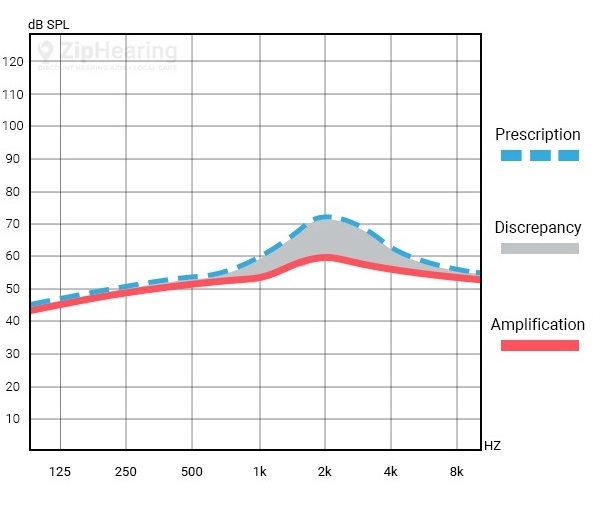
The blue dotted line represents how the hearing aids should be amplifying, based on your unique hearing loss and prescription.
The red solid line represents how the hearing aid are actually amplifying, as measured by the microphone.
The grey area illustrates the discrepancy between how the hearing aid should be amplifying, and how it actually is.
What this chart shows: The results show that the hearing aids are under amplifying at around 2kHz.
As a result of this under amplification, the hearing provider can now fix this, by increasing the gain that the hearing aids provide at 2kHz.
After making that fix, the provider will then run real ear measures again, this time hoping for the solid and hashed lines to be on top of each other.
If the lines are on top of each other, that indicates that the hearing aids are providing exactly the right amount of amplification at each frequency.
This is the purpose of real ear measurement- to objectively verify that the hearing aids are doing what they should be.
Imagine a scenario where a hearing aid was under-amplifying, providing insufficient sound amplification for the wearer. If this error had gone unnoticed by real-ear measurement (REM) and remained uncorrected by the hearing care provider, the hearing aid wearer might have been content with the sound quality. However, after the issue was identified and rectified, leading to increased gain, the wearer would achieve better speech understanding and clarity.
In most cases, the fee for real ear measurement will be bundled into the purchase price of your hearing aids, if you are purchasing new hearing aids and not using an insurance-sponsored discount program to purchase them.
The fee for performing real ear measurements on other hearing aids will usually range from $100 to as much as $250 per hearing aid.